
Thursday, February 12, 2009

Thursday, January 29, 2009
Urban Landscapes - William Morris Meets City Grunge
Urban Landscapes can be anything from buildings, to art, to the people that inhabit the spaces. The Visual Communications class was asked to create Victorian inspired wallpaper from elements of an urban landscape image. I chose graffiti because it not only reflects the built environment, but the cultural and social landscape as well. I then used William Morris Nettle wallpaper as a reference for the new product.


Sunday, January 25, 2009
Computing in Architectural Design - Response
Computers have become such an integral and integrated part of our lives today, functioning as both tools, means of communication, assistants and play spaces. In the world of design, computers are the keystone to the design process, but it was not always this way. In Yehuda Kalay’s book, Architecture’s New Media, the author discusses the evolution of computer based design programs. There were several aspects that I found interesting regarding the past, present and future use of design programs.
According to Kalay, architectural design technology is actually changing the way the built environment is conceived. As technology has progressed, computers have been used in different ways, at different levels of uses, volition and intelligence. Computers are used as design tools. In this instance, computer programs are “instruments with no intelligence or volition of their own”. Computers are used as a means of communication, acting as a link between “distant collaborators”, compiling the “joint effort of many specialists”. Computers can be used as design assistants or travel agents, filling in the holes when short sighted designers miss big problems. In this instance, computer programs have the ability to carry out “complex tasks and have to the volition to do so on their own, computers can go beyond the abilities of their human operators”. This may or may not be a good thing in the future. Lastly, computing is a design environment. In essence, just about every aspect of our lives have us chained to the computer, whether it be Facebook, AIM, the news or CAD. Design is chained to technology. Designers are starting to be unable to creatively function without the aid of their drafting program. Will the ultimately be detrimental to overall human creativity?
With this in mind, one begins to weigh the pros and cons of computers in today’s designs. On the pros side, benefits of computing in today’s designs are undeniable. We are able to visualize designs, make changes quickly, and explore small elements of design more thoroughly without having to concentrate as much on computations, which are taken care of by design programs. Today’s design programs are brilliant, going to far as to actually building the model, with the touch of a single human hand.
While this may be fantastic, it brings up the questions of human obsoleteness and artistic integrity. Kalay discusses how modern computer programs have worked to become more intuitive, placing staircases at the click a button and flashing warnings of overheated wires in places a designer did not see them. What will happen to craftsmanship? What will happen to spontaneity in design? What will happen to humans having to actually sit down and think about design solutions instead of just punching in numbers into a program and taking the easy way out?
Today’s design programs teach students a dependence on computers, which may or may not be a good thing. Students are able to learn much more information in a shorter period of time, but they aren’t learning the same things as craftsman 50 years before them. Yes technology advances, but will students lose the ability to think for themselves.
While there are concerns for the future of design and computing in design, the vast potential for the future is brilliant. In the past, advances in computational technology helped to advance the aerospace and automobile industries. Leaps and bounds were made in technology due to technology, and one can only imaging the potential in the future. Future systems could help the environment, not to manage it as most computers are programmed to do, but instead to provide humans with solutions that are better thought out.
The ability of computers to be so far reaching is a little scary, admittedly. Technology has increased so much in the past, with both positive and negative impacts. One may think that humans need to put a leash on technology and computing, but that may or may not be possible.
In terms of computing in design in the future, I think that there will be so many new programs it will be dizzying. I think that there needs to be a balance between craftsmanship and technology, or an integration of the two.
Tuesday, December 2, 2008
Building Blocks for Better Communities - Studio Final Project
Shelter/Bus II - The final studio project was to design an inventive and thoughtful shelter | bus to meet the needs of the following four hurricane relief workers in
Eastern North Carolina:
• Lynn : a visually-impaired teacher, plays guitar, conservative Jew
• Chris : an African American nurse, training for a marathon, works 3rd shift
• Siu : a language teacher, Montagnard, broke leg recently and on crutches
• Chi Chi : a nurse from New Mexico, has a pet bird, Hispanic
With this came Building Blocks for Better Communities.
Concept: Building Blocks are a collection of basic shapes that stimulate the imagination of children. The idea of a manipulable environment lets children do what they do best: construct their own world, break it down and rebuild it. Building Blocks for Better Communities provides a bottom up approach to disaster relief, while maintaining the functional and entertaining aspects of simple building blocks. Transformation, material and color are linked to explain spaces and movement.


Floorplan Cross Section 1 / Cross Section 2

 Interior Playground Detail
 Interior Playground Detail
 Interior 2nd Floor Lounge Perspective
 Section in Perspective
Site Transformation: the unit is site dependent, on a narrow site the unit is stacked vertically, on a wider site, the top and bottom portions can be detached and placed adjacently

Room/Box Transformation: rooms slide out of mainframe on a track system to create more interior space


Roof Transformation: Roof panels expand up to increase interior ceiling height

Furniture Transformation: movement of furniture and appliances reflects building blocks in that it can telescope, nest or stack

Eastern North Carolina:
• Lynn : a visually-impaired teacher, plays guitar, conservative Jew
• Chris : an African American nurse, training for a marathon, works 3rd shift
• Siu : a language teacher, Montagnard, broke leg recently and on crutches
• Chi Chi : a nurse from New Mexico, has a pet bird, Hispanic
With this came Building Blocks for Better Communities.
Concept: Building Blocks are a collection of basic shapes that stimulate the imagination of children. The idea of a manipulable environment lets children do what they do best: construct their own world, break it down and rebuild it. Building Blocks for Better Communities provides a bottom up approach to disaster relief, while maintaining the functional and entertaining aspects of simple building blocks. Transformation, material and color are linked to explain spaces and movement.


Floorplan
 Cross Section 1 / Cross Section 2
 Interior Playground Detail
 Interior Playground Detail
 Interior 2nd Floor Lounge Perspective
 Section in Perspective
Site Transformation: the unit is site dependent, on a narrow site the unit is stacked vertically, on a wider site, the top and bottom portions can be detached and placed adjacently

Room/Box Transformation: rooms slide out of mainframe on a track system to create more interior space


Roof Transformation: Roof panels expand up to increase interior ceiling height

Furniture Transformation: movement of furniture and appliances reflects building blocks in that it can telescope, nest or stack


Friday, October 17, 2008
Vernacular Innovation - Snaggle & Snaggle Design
Snaggle & Snaggle Design, Inc. would like to present the latest in Bus Shelter design for the Community by Design IARC Studio. Last week, we were challenged to design Bus Shelters for the Weatherspoon Gallery and A&T Campus. Of these, four finalists were chosen. This week's challenge was to modify these finalists, and come up with more complete designs and concepts. The Clubs, or Snaggle & Snaggle Design, Inc. would like to present Vernacular Innovation.
Concept Statement:
Although the term sustainability has become increasingly prevalent in everyday vocabulary, it has yet to infiltrate the built environment in a similar way. Many people may still think of sustainability as an expensive, distant, idealistic value, meant for design magazines and wealthy environmentalists, but in fact, green design can take the form of something as simple and common as a bus shelter. A familiar, understated structure can make a powerful statement. The detail in the simplicity of the structure demonstrates that, even using recognizable materials such as glass, aluminum and stainless steel, a vernacular structure can still be sustainable.
Change often happens slowly and subtly, step by step, so by introducing a green roof system to a familiar form, this shelter can begin to inspire change not only in the bus system, but in society as a whole. Each of the different materials incorporated into the structure is sustainable, demonstrating the way in which sustainability can and should permeate all levels of society. The green roof of the bus shelter does not impact the function of the structure per se, but it does stand as an icon for the way in which the bus system itself can be an eco-friendly transportation option. Furthermore, the use of glass, which in this case creates the ability to see through the entire structure, as well as the use of clean lines and corrugated aluminum roofing are in keeping with the contemporary architecture of the North Carolina A & T campus nearby, testifying to the fact that green design can be integrated into a variety of aesthetics.


The Clubs: Lauren Shepulski, Christyn Dunning, Diana Stanisic, Emme Zheng, Heather Link, Jamie Hilton, Jayson Parker, Kurt Huizenga, Laura Dipasquale, Lauren Foster, Maiken Schoenleber, Nacarra Lessane and Sara Easterling
Concept Statement:
Although the term sustainability has become increasingly prevalent in everyday vocabulary, it has yet to infiltrate the built environment in a similar way. Many people may still think of sustainability as an expensive, distant, idealistic value, meant for design magazines and wealthy environmentalists, but in fact, green design can take the form of something as simple and common as a bus shelter. A familiar, understated structure can make a powerful statement. The detail in the simplicity of the structure demonstrates that, even using recognizable materials such as glass, aluminum and stainless steel, a vernacular structure can still be sustainable.
Change often happens slowly and subtly, step by step, so by introducing a green roof system to a familiar form, this shelter can begin to inspire change not only in the bus system, but in society as a whole. Each of the different materials incorporated into the structure is sustainable, demonstrating the way in which sustainability can and should permeate all levels of society. The green roof of the bus shelter does not impact the function of the structure per se, but it does stand as an icon for the way in which the bus system itself can be an eco-friendly transportation option. Furthermore, the use of glass, which in this case creates the ability to see through the entire structure, as well as the use of clean lines and corrugated aluminum roofing are in keeping with the contemporary architecture of the North Carolina A & T campus nearby, testifying to the fact that green design can be integrated into a variety of aesthetics.


The Clubs: Lauren Shepulski, Christyn Dunning, Diana Stanisic, Emme Zheng, Heather Link, Jamie Hilton, Jayson Parker, Kurt Huizenga, Laura Dipasquale, Lauren Foster, Maiken Schoenleber, Nacarra Lessane and Sara Easterling
Monday, October 13, 2008
Geometric Illumination - Bus/Shelter
Last week's project was to design a Bus/Shelter on A&T campus. The shelter was located on East Market, between A&T campus and St. John's Lodge. We were challenged to create a shelter that fit with the site, but could also potentially be built. For this particular site and shelter, I pulled cues from the buildings on A&T campus and from the Church across the street. On campus, I noticed that the buildings are very modern looking, in that they emphasized rectilinear forms and structural severity. The main building materials seemed to be glass and steel. The church across the street was stone, and emphasized triangular forms on the facade decoration. In designing for this shelter, I thought that it was very important to recognize these two very obvious influences for the community in this area, the campus and the general community, embodied in the church. I wanted to pull influences from both together to create a cohesive design.
The concept for the shelter was Geometric Illumination. I used rectangular forms horizontally and vertically to reflect the architecture on campus. These forms are articulated by natural light during the day. Then I used the triangular forms from the church across the street, and articulated them by backlighting plexiglas cutouts inside glass columns. By emphasizing the two elements in the same structure, the design presents a combination of communities.


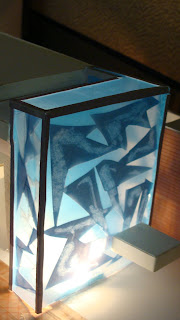
The concept for the shelter was Geometric Illumination. I used rectangular forms horizontally and vertically to reflect the architecture on campus. These forms are articulated by natural light during the day. Then I used the triangular forms from the church across the street, and articulated them by backlighting plexiglas cutouts inside glass columns. By emphasizing the two elements in the same structure, the design presents a combination of communities.


Subscribe to:
Posts (Atom)